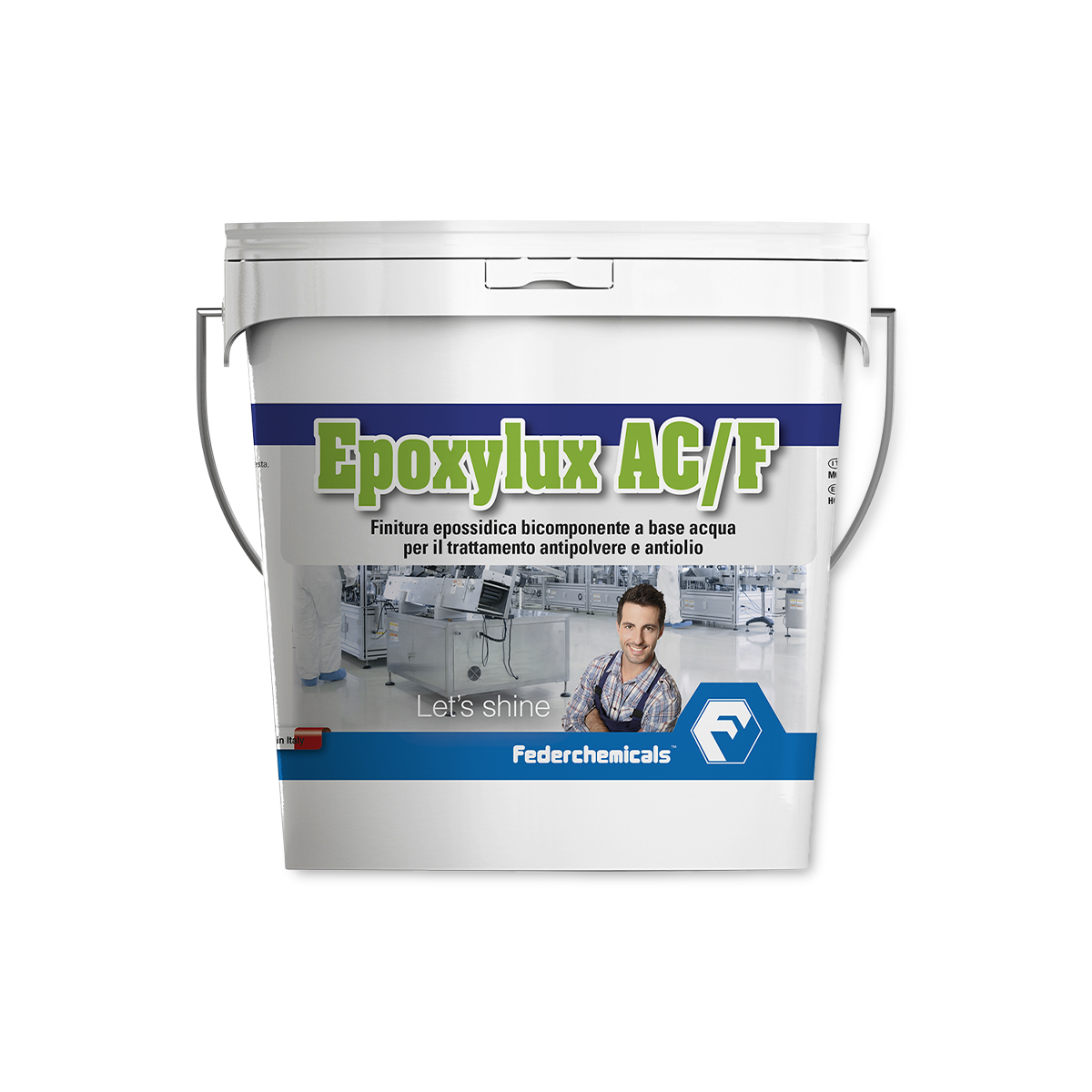

Description
HOW TO USE
PREPARATION OF THE SUPPORT: eliminate all loose parts, any irregularities must be fixed beforehand. It is recommended to sand thoroughly before applying EPOXYLUX AC/F and then carefully remove dust with industrial vacuum cleaners to ensure correct adhesion to the substrate. Traces of oil and grease, release agents, paints, etc. must always be removed, in which case we recommend using the ZERO OIL product.
APPLICATION: apply the product using a short or medium-haired roller or by spraying. The product can be applied within 1-2 hours, depending on the room temperature.
Apply the product at a temperature between +8°C and +35°C. In closed environments it may be necessary to use hot and dry air to facilitate hardening. Protect the film from water until complete catalysis. Long exposure to UV rays may cause a slight yellowing in the case of light-colored coatings.
PREPARATION OF THE SUPPORT: it is recommended to mix the two liquid components separately, in a first phase, and then combine them by pouring component B (small can) into the container of component A, then mix carefully with a drill equipped with a stirrer, at low speed, for a few minutes, until obtaining an emulsion of uniform color and free of streaks. Then slowly add, while continuously stirring, any water needed in an appropriate proportion with respect to the intended application (first coat 10%, subsequent coats without dilution) and mix for a few minutes until obtaining a homogeneous mixture again. If you want to obtain non-slip characteristics, add the SAFE STEP 13 at a rate of 5%+10% by weight, keeping the product under stirring for a few minutes to avoid sedimentation of the inert material.
TOOL CLEANING
The equipment used for the preparation and application of EPOXYLUX AC/F they can be cleaned immediately with water, even in the case of prolonged stops.
INDICATIVE COVERAGE
0.15-0.20 kg/m2 per coat, depending on the characteristics of the substrate.
STORAGE
The shelf life of the product is 12 months from the date of the delivery note, provided that the material is stored indoors, in the original sealed container and protected from heat sources and frost. If the material has been kept beyond the recommended shelf life, it is not necessarily unusable, but a quality control must be performed beforehand on the characteristics pertaining to the application.