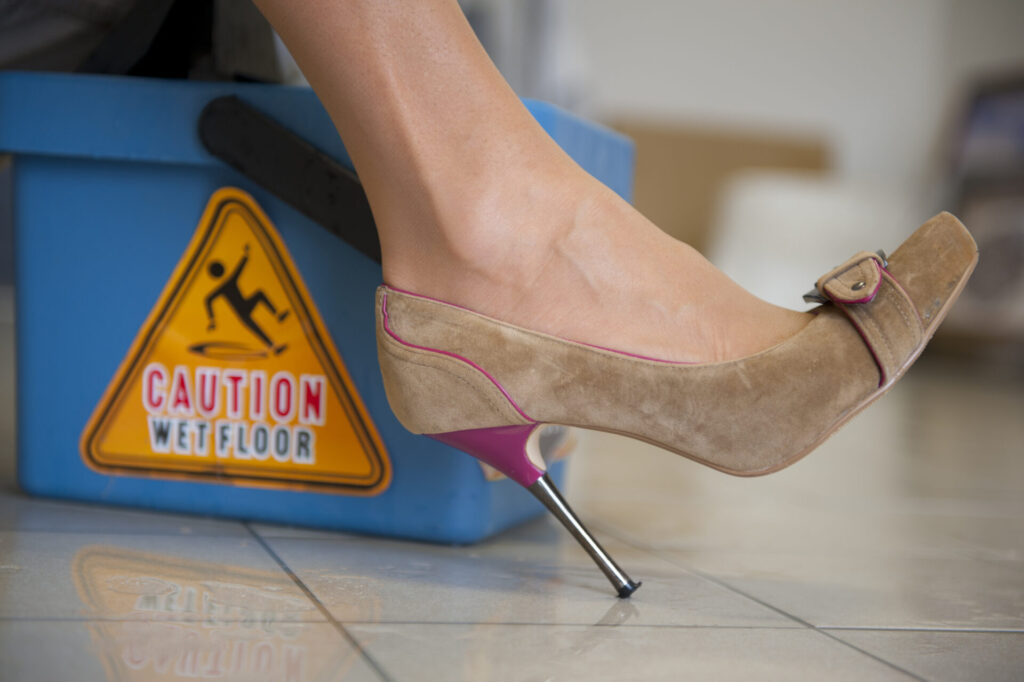
The importance of choosing non-slip flooring.
The choice of construction and type of flooring is often based not only on aesthetic criteria, but also on the nature of the internal and external environment in which the surfaces are used, whether they are stoneware tiles or marble and natural stones, epoxy resins or other: the technical characteristics required for the floors of the living room or bedroom, for example, are not the same as those of the bathroom in a swimming pool area.
In any case, the surface must be covered with material that guarantees anti-slip characteristics to avoid falls and other unpleasant accidents.
The need to avoid accidental falls has become fundamental in the domestic environment in general but especially in all those public environments with high pedestrian traffic.
Just think about the importance of having non-slip flooring in environments where the floor may be wet such as: outdoor flooring, walkways, pool edges, stairs, hospitals, shopping centres or surfaces where there may be the presence of grease or oily substances that facilitate slipping such as industrial kitchens or fast food restaurants.
But what are the anti-slip characteristics that floors must have?
What are the Italian regulations applicable to civil flooring, public flooring and workplaces?
Whether they are floors made of stoneware or marble tiles, natural stones, coverings made with epoxy resins, stamped concrete floors or industrial floors such as polished polished concrete, the regulatory references relating to non-slip flooring are the following:
Legislative Decree 81/2008 (Consolidated Law on Safety) – Annex IV – WORKPLACE REQUIREMENTS point 1.3.2)
Legislative Decree 81/2008, also known as the Consolidated Law on Safety in the Workplace, states that: “the floors must have conditions that make the movement and transit of people and vehicles safe.
In particular, Annex IV of Legislative Decree 81/2008 specifies: the floors of the rooms must be "fixed, stable and non-slip as well as free from protuberances, cavities or dangerous inclined planes, in addition to not being cluttered by materials that could impede normal circulation"
In the parts of the rooms where putrescible substances or liquids are usually spilled on the floor, the floor must have anti-slip characteristics (dynamic friction coefficient µ<0.4), a smooth and impermeable surface and a sufficient slope to quickly direct the liquids towards the collection and discharge points”
https://www.gazzettaufficiale.it/eli/id/2008/04/30/008G0104/sg
Ministerial Decree 236/1989 (Technical requirements for the purpose of overcoming and eliminating architectural barriers) – Paving.
art. 4.2.2 The pavement of the pedestrian path must be non-slip…..
art. 4.1.10 The steps of the stairs must have a non-slip tread……
art. 8.2.2 A non-slip floor is a floor made with materials whose friction coefficient, measured according to the BCRA (British Ceramic Research Association) method, is greater than: 0.40 for a leather sliding element on a dry floor – 0.40 for a rubber sliding element on a wet floor – the aforementioned friction values must not be modified by the application of polishing or protective finishing layers, which must be applied to the materials before the test. The hypotheses of dry or wet flooring must be assumed on the basis of the normal conditions of the place where it is installed….
https://www.gazzettaufficiale.it/eli/id/1989/06/23/089G0298/sg
What is meant by the BRCA method?
It is a method derived from the English (BCRA: British Ceramic Research Association) and measures the dynamic friction coefficient μ. This friction coefficient is measured by determining the dynamic friction between the sample to be tested and a sliding element moving at a constant speed (17 mm/s) on the surface of the sample. The value of the dynamic friction coefficient μ is equal to the ratio between the friction resistance force, opposite to the direction of motion, which acts on the sliding element and the weight force. The sliding element is integral with a system which, via an electronic measurement transducer, gives a signal in millivolts proportional to the friction coefficient. The measurements are usually carried out using a portable device equipped with an electric motor which moves at a constant speed on the surface to be tested. The sliding element can be made of different materials (rubber, leather). The dynamic friction coefficient is determined, both average and specific, in defined surface conditions (dry and wet). This method can be used both in the laboratory and in the field.
According to the BCRA test, the Dynamic Coefficient of Friction (DCOF) values are divided as follows:
- dangerous slipperiness: value less than 0.2
- excessive slipperiness: value greater than/equal to 0.2 and less than 0.4
- satisfactory friction: value greater than/equal to 0.4 and less than 0.74
- excellent friction: value greater than 0.74
Slip resistance is expressed by the coefficient of friction. In short, the higher this value, the less slippery the flooring will be.
Obviously the acceptable parameters are equal to or exceed a value greater than/equal to 0.4
Therefore, complying with the legal parameters is a basic requirement that can never be overlooked to ensure safety and prevent potential injuries in any environment.

Federchemicals leader in the development of products for the treatment of concrete floors