
Description
HOW TO USE
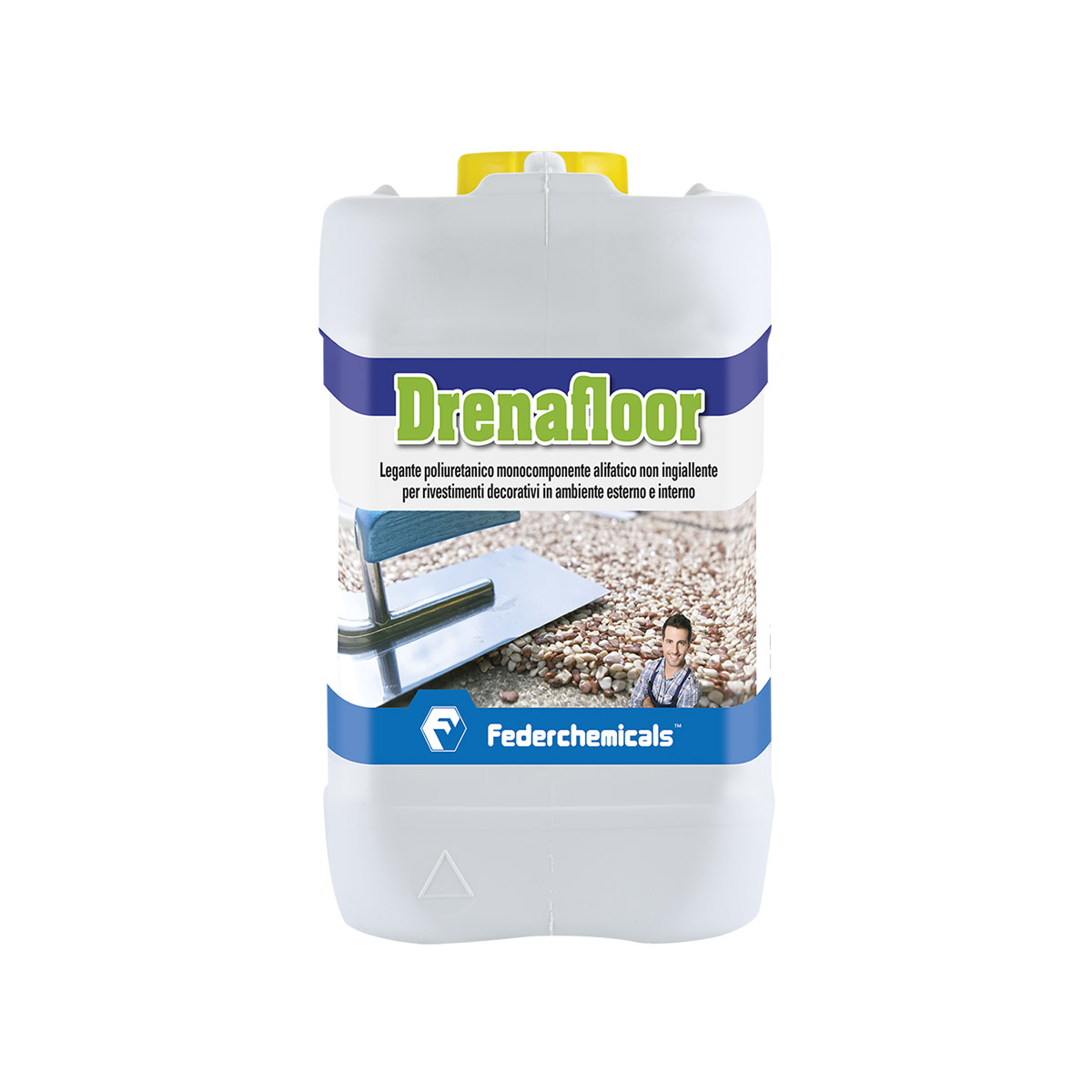
DRENAFLOOR It must be mixed with natural stones or quartz or decorative granite to create decorative, rigid coatings for internal and external surfaces such as access roads, pool edges, driveways, porches and concrete or draining screed.
PREPARATION OF THE SUBSTRATE: the surface must be dry, stable, cohesive and not have any type of unwanted residue such as oil, dirt, dust or anything else that could compromise adhesion. In any case, it is advisable to evaluate possible consolidation through the use of primer. Mandatory slope of the surfaces or drains to avoid water stagnation.
PRODUCT PREPARATION: natural stones or decorative quartz in the desired colour must be mixed (depending on the grain size) with approx. 4-6% by weight of DRENAFLOOR using a slow-speed drill (approx. 400 rpm) until all the pebbles are covered with resin. Once the mixture has been obtained, it must be transferred to a clean container and mixed briefly again.
At this point, you have a working time of approx. 60-75 minutes for processing. The application of a layer of adhesive is not necessary if the consolidation was carried out with quartz dusting.
If natural stones are used (2-4 mm), an average thickness of the cladding of at least 8 mm must be considered.
Then spread it first roughly, to the desired thickness, using a large spatula and then smooth and press it to around 8 mm. For driveable surfaces with 2-4 mm aggregate, a minimum thickness of 15 mm is recommended.
The minimum thickness to be considered for walkability is in any case in relation to double the size of the largest aggregate used, for example:
– inert 2-4 mm minimum construction thickness 8 mm.
– inert 3-6 mm minimum construction thickness 12 mm.
The values change significantly if it is necessary to build on top of pre-existing asphalt pavement (3-4 cm).
To facilitate the smoothing work, especially if you use quartz with a finer grain size, we recommend frequently moistening the spatula with thinner to make the surface more slippery. The surfaces can be walked on, with caution, after approx. 8 hours. They can be fully loaded after approx. 2 days.
| APPLICATION DATA | |
|---|---|
| Base | polyurethane resin and additives |
| Working temperature | from +8°C up to 30°C |
| Pot life | max 75 minutes |
| Density (23°C) | 1120 kg/cm3 |
| Viscosity (25°C) | About 420 mPas |
| Color | Transparent |
| Walkable with caution | After approx. 8 hours |
| Hardened and fully stressable | After approx. 2 days |
| Percentage of use on 2-4 mm | 5% approx. |
IDENTIFICATION RETURN
With 2-4 mm aggregate grain size, to obtain a thickness of 8 mm, approximately 15-16 kg of aggregate and 0.750 – 0.800 kg of DRENAFLOOR will be used.
USE AND HARDENING TIMES
Processing: the working temperature must be between 8°C and + 30°C, low temperatures slow down the catalysis while high temperatures accelerate the hardening time, it is strictly recommended to avoid strong solar radiation during the working phases, furthermore the resin reacts in contact with humidity therefore the surface must be protected from humidity until completely dry and must be perfectly dry, evaluate with a digital hygrometer before any application. The mixing times and doses must always be the same to obtain homogeneous workings. Protect the obtained surface from rain both during the laying phase and until the end of the hardening cycle. For creations on a new screed the support must be matured for at least 28 days.
Dosages: respect the dosages to avoid shading on the surface, any overdosage of the binder can cause the formation of bubbles and craters.
Inert: make sure that the aggregate is perfectly dry because the presence of humidity causes a loss of cohesion; compacting the surface is essential for the success of the work.
STORAGE
The product has a shelf life of 6 months in the original unopened packaging, stored in a cool, dry environment at a temperature between 10°C and 30°C.